A Calm Homework Routine: Checklists, Prompts, AI Help

Helping Kids With Homework Without the Nightly Struggle
Homework time can turn into a daily power struggle when kids feel overwhelmed and parents feel stretched thin. A predictable routine, clear expectations, and the right kind of learning support can reduce stress while still building independence. The goal isn’t a perfect evening—it’s a repeatable plan your child can follow even on busy days.
Why homework gets hard (and what’s usually missing)
Most homework battles aren’t about laziness. They’re usually about uncertainty, overload, or friction in the environment—especially after a full school day.
- Unclear start and end points: Kids resist when homework feels endless or open-ended.
- Task overload: Multiple subjects, new instructions, and “hidden steps” can exceed working memory.
- Environment friction: Noise, hunger, missing supplies, and screens quietly drain focus.
- Parent-child role confusion: “Helper” turns into “manager,” and conflict rises fast.
- Lack of a repeatable plan: Motivation drops when every day feels different.
Helpful references from child-development and education organizations reinforce the value of routines and study habits, including guidance from HealthyChildren.org (American Academy of Pediatrics) and the National Association of School Psychologists.
Set up a homework routine that runs on autopilot
A routine works best when it’s simple enough to repeat, even when everyone is tired. Think “same steps, flexible timing.”
- Choose a consistent time window tied to an existing habit (snack, after-school break, or after dinner).
- Create a start ritual: water bottle filled, supplies out, assignments listed, timer set.
- Use “first-then” momentum: first one small task, then a short break.
- Define the finish line: homework checked, bag packed, workspace reset.
- Keep it visible: a printed checklist cuts down on repeated reminders.
Sample weekday homework routine (adjust by age and workload)
| Step | Time | What to do | Parent role |
|---|---|---|---|
| Decompress | 10–20 min | Snack, movement, quick chat about the day | Connect, don’t coach |
| Plan | 5 min | List assignments, estimate time, pick first task | Guide planning, avoid solving |
| Focus block 1 | 15–30 min | Work on the hardest subject first | Check in once mid-block |
| Break | 5–10 min | Water, stretch, short reset (no scrolling) | Keep it short and neutral |
| Focus block 2 | 15–30 min | Finish remaining tasks or review | Answer questions; prompt thinking |
| Wrap-up | 5 min | Check directions, pack bag, set out items for tomorrow | Confirm completion, praise effort |
Make the study space work harder than you do
The environment can either “hold the routine” or sabotage it. Set up a default space so you don’t have to negotiate nightly.
- Pick one default spot: consistency reduces stalling and debates.
- Stock a homework caddy: pencils, highlighter, paper, charger, calculator, sticky notes.
- Reduce distractions: phone parked outside the workspace; notifications off during focus blocks.
- Use lighting and posture helpers: good light, stable chair, clutter-free surface.
- For younger kids: sit nearby doing quiet work so help is available without hovering.
Support without taking over: prompts that build independence
Kids gain confidence when they feel ownership. The trick is to guide the process without becoming the doer.
- Swap “Let me do it” for questions: “What does the direction ask?” “What’s your first step?”
- Try the 3-try rule: try independently, check notes/example, then ask for help.
- Chunk assignments: one problem, one paragraph, or one section at a time.
- Coach organization: mark due dates and identify what must be turned in.
- End with a self-check: “Did I answer every part?” “Is my work readable?”
If emotions spike, pause the content and reset the tone: a calm, brief break often restores problem-solving faster than pushing through.
Using AI learning support the right way (ethical and effective)
AI can be a helpful tutor when it’s used for understanding—not for skipping the learning. Guidelines for responsible use are increasingly emphasized in education, including recommendations from UNESCO’s guidance on generative AI in education.
- Use it as a tutor, not a shortcut: request explanations, examples, and steps.
- Kid-friendly requests: “Explain this like I’m in 4th/7th grade,” “Show two ways,” “Give practice questions with answers.”
- Verify accuracy: compare with class notes, textbook examples, and teacher directions.
- Protect academic integrity: don’t submit AI-generated writing as original work; use it for outlines, feedback, and clarity.
- Require reflection: after help, your child summarizes the concept in their own words.
Checklists that reduce reminders and arguments
Checklists turn repeated verbal reminders into a neutral system. Kids can “check the list” instead of feeling corrected.
When homework is still a battle: practical next moves
A printable routine + eBook to make it easier to stick with
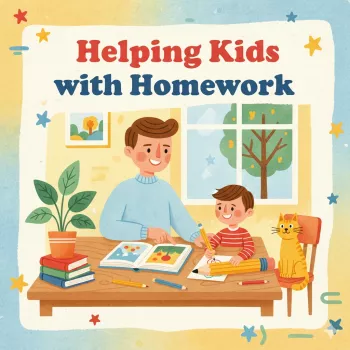
- Helping Kids with Homework digital download guide (structured routine, checklists, and ethical AI learning support guidance).
- Baby’s First Cold Survival Checklist printable (a practical companion for the weeks when sick days derail your usual schedule).
FAQ
How long should homework take each night?
A common guideline is about 10 minutes per grade level (for example, 30 minutes in 3rd grade and around 60 minutes in 6th), but individual teachers and schools vary. If it regularly runs far longer than expected, it’s worth checking in with the teacher to confirm what “typical” looks like.
What’s the best way to help without doing the work?
Use prompts instead of solutions: ask what the directions require, what the first step is, and what example in notes matches the problem. Combine the 3-try rule with chunking so your child practices starting independently while still getting support when they’re truly stuck.
Is it okay to use AI for homework help?
Yes—when it’s used for tutoring: explanations, step-by-step walkthroughs, practice questions, and feedback on clarity. It’s not appropriate to submit AI-written answers as original work; have your child verify information with class materials and explain the idea in their own words.







Leave a comment